The Concept of Green Purchasing The Concept of Green Purchasing
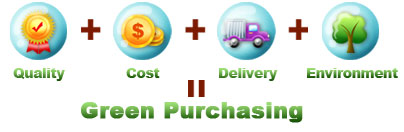
Green purchasing involves identifying, selecting and purchasing products (i.e. goods and services) with significantly less adverse environmental impacts than competing products. Further, it involves considering the costs and environmental characteristics and performance of a product in all stages of its life-cycle, from product design, development and production/provision, through product use, to the ultimate handling (i.e. recovery, recycling, re-use and/or waste disposal) of whatever remains of the product at the end of its useful lifespan.
Ideally, while green purchasing considers multiple environmentally preferable aspects and associated reduced impacts of products through entire life-cycles, where possible and appropriate, it should target and give greatest preference to those products that are environmental leaders from a cumulative and full life-cycle perspective.
|
THE Importance of Green Purchasing
Sustainable development involves using the Earth's natural resources (i.e. both renewable and non-renewable resources) to fulfil our present needs without affecting the needs of next generations. "Green Purchasing" is an important element to achieve sustainable development. Consequently, when one considers buying something, he/she should think about the adverse environmental impacts associated with the product during its full life-cycle.
However, environmentally preferable products are sometimes more expensive to purchase than alternative products. This circumstance can discourage green purchasing by consumers seeking lower costing products without significant environmental benefits. Nevertheless, buying "greener products" doesn't necessarily mean paying more, especially when other cost factors are considered.
For instant, although T5 compact fluorescent lamps (CFLs) are initially more expensive than alternative tungsten bulbs and other CFLs (i.e. T8, T12), T5 CFLs are more energy efficient and durable, have higher illumination levels, and when selected and used can actually lead to net financial savings due to significantly lower operational costs over the product life-cycle. At the same time, and from an environmental performance perspective, T5 CFLs not only require less energy and reduce carbon dioxide (CO2) emissions indirectly, but also help reduce landfill burden due to their relative long lifespans. Further, their higher illumination levels enable resource savings in terms of reduced requirements for and use of aluminium in fixtures and lamps.
It is important to recognize and appreciate that proper and effective green purchasing doesn't simply lead to environmental benefits, but also helps purchasers reduce full life-cycle costs and thus save money. For practitioners, another significant benefit of green purchasing is the major contribution its adoption and application can make to the establishment and demonstration of a broader overall Corporate Social Responsibility (CSR) strategy and image.
|
FIVE KEY STEPS FOR Implementing Green Purchasing
To introduce and implement green purchasing within an organization, the following measures must be considered, addressed and completed in a step-by-step manner:
- Research, formulate and adopt green purchasing policies;
- Develop purchasing criteria / specifications and procedures;
- Communicate green purchasing objectives, imposed requirements and desired outcomes with suppliers (existing and potential) and other stakeholders;
- Raise staff awareness, competence and commitment through various internal informational and promotional initiatives and activities, including training; &
- Monitor initiatives and measure and report upon impacts and results.
1. Research, formulate and adopt green purchasing policies
Many organizations have already developed green purchasing policies that can guide others considering the development of their own. At the same time, initial and sustained commitment from top management is critical to the implementation and advancement of green purchasing within a company. Green purchasing policy is the expression of top management on preference for and implementation of green purchasing. Typically, the green purchasing statements include a commitment on giving preference to and selecting "greener" products, intention to stimulate and establish a green supply chain, etc.
2. Develop purchasing criteria and procedures
When we choose to identify and select environmentally preferable products, their life- cycle stages should cumulatively (and individually to the greatest extent possible) have the following characteristics:
- Cause minimal adverse environmental impacts;
- Incorporate as much recycled content and salvagable/reusable materials as possible, leading to highly reusable/recyclable/recoverable product components for which recycling facilities or collection systems are available and arranged (or encouraged) to be used;
- Avoid, or at least minimize the incorporation or use of, hazardous chemicals/ materials that cause environmental harm and jeopardize the health of producers and users;
- Result in reusable, refillable and biodegradable products for waste avoidance or reduction [whenever practical];
- Conserve energy and natural resources; and
- Incorporate and optimize renewable resources use [throughout the full life-cycle and in terms of both material inputs and energy sources].
In addition, the following are some factors that should be considered prior to the selection and purchase of a specific product within a product category:
- Necessity – from a broad perspective and in terms of urgency to obtain
- Existence of a comparable or even better alternative -- i.e. is there a product that is equivalent or even more application-appropriate, environmentally preferable and/or user safe
- Extent of environmental design applied in terms of such features as durability, disassembly for recovery or recycling, overall recyclability, energy efficiency and savings aspects, biodegradability, etc.
- Product origin -- i.e. locally/regionally produced versus exported
- Transportation distance from the production site to the location(s) for assembly, marketing and/or use
- Avoidance of any product containing unnecessary/inappropriate banned, restricted or hazardous/toxic/poisonous/dangerous substance(s)
- Avoidance of any product incorporating exotic/endangered materials
- [If possible] Avoidance of any product requiring special disposal considerations (e.g. a product containing hazardous materials) OR identification/confirmation of appropriate and accessible facilities to enable proper and safe disposal of such a product after its useful lifespan
- Appreciation of products designed for easy maintenance and repair
- Size and magnitude considerations -- i.e. is there a better available option
- Packaging -- i.e. minimal use, application of principles of reduction, re-use, recycled content and recyclability, etc.
In addition to the environmental performance merits of the products, the environmental performance of the products' suppliers should also be addressed. The following are some factors for consideration:
- Supplier's [publicly] stated environmental values and commitments
- Environmental certificate or award, environmental measures and enforcement programme
- Supplier's environmental management system or quality management system that incorporates environmental considerations
- Full compliance with applicable environmental regulations and legislation
- Interest in and willingness to meet your organization's environmental specifications, and to cooperate with your organization in reviewing and potentially enhancing the specifications in order to achieve greater environmental benefits
3. Communicate with suppliers and other stakeholders
It is necessary to communicate with vendors/suppliers to alert and orient them on your organization's green purchasing policy(ies) and specifications, and to seek and obtain relevant feedback and information input. With increasing concern about and attention given to the environment, there is a corresponding and growing environmentally preferable products market segment covering many product categories. A good and effective way of increasing knowledge and awareness about the latest and most innovative greener technology options and products is to identify and communicate regularly with existing greener products suppliers and others in the process of greening their supply chains, operations and product offerings.
4. Raising staff awareness, competence and commitment
Properly identifying and assessing environmentally preferable products is not a simple exercise. It involves determination, description, review and consideration of environmental issues and corresponding product aspects from a full product life-cycle perspective. In addition, the environmental characteristics and performance information available from the product developers, producers, suppliers and marketers relating to all the product life-cycle stages can be overwhelming, unclear, incomplete, complicated and even misleading. Consequently, organizational staff need to acquire basic knowledge, confidence and certain guidance and skills in order to properly secure, process and assess appropriate information and competently make appropriate purchasing decisions. In this regard, regular environmentally responsible purchasing training courses can and should be arranged and provided for officials expected to participate in green purchasing decision-making processes and activities. Along with information transfer and instruction, the training sessions should also include promotional and team-building aspects to stimulate and increase staff enthusiasm and commitment.
Furthermore, "greener alternatives" research and investigation (e.g. identification and expanding awareness of new environmental technologies, products' availability, etc.) is highly desirable, valuable and should be undertaken in order to gather and review as much information as possible about environmental considerations and greener alternatives in product categories of interest. In this regard, the CyberGreen Centre (refer to http://www.greencouncil.org/eng/cgc/products.asp) is a Hong Kong based data base service that collects and shares relevant and current information for public consideration and reference.
5. Monitoring initiatives and determining impacts and results
After launching a green purchasing program or initiative, it is desirable and logical to put in place means to record, assess and report on efforts and achievements. At the same time, objectives and achievement targets should be regularly reviewed in order to plan and implement growth and continuous improvement in the area of green purchasing. Two key activities that should be devised and conducted routinely, are:
a) Internal Review
An internal review exercise (e.g. written or electronic survey/questionnaire and/or internal review meeting(s)) should be planned and conducted at the end of a given time period (e.g. once a year). Some review objectives could be to:
- re-consider efforts and approaches taken and critically assess results;
- identify any obstacles or challenges encountered and formulate strategies to address and [hopefully] overcome these; and
- research/investigate and give consideration to emerging green purchasing trends (both internal and within the marketplace) and green products advancements within certain product categories of specific interest going forward.
Such a routine internal review should help re-enforce and improve the green purchasing process and increase the probably of environmental performance improvement targets being achieved.
b) Evaluation of Economic Impact
Green purchasing, especially when it involves waste reduction and/or energy saving strategies and measures, usually results in some cost avoidance and/or savings. For example, selecting, purchasing and properly using higher energy efficiency and/or energy saving photocopiers can help reduce applicable electricity costs on a continuous and substantial basis. Similarly, avoiding the purchase and use of products containing hazardous chemicals can protect staff health and safety, but may also reduce waste disposal requirements and associated costs (i.e. it may be easier and cheaper to dispose of non-hazardous wastes only) and may further result in less staff medical expenses claims.
|
AFTER INITIAL IMPLEMENTATION,
Join YOUR Local Green Purchasing Network
Continuous improvement and increasing scope are both desirable objectives of any green purchasing schemes. It is quite impractical to try to implement green purchasing for all products at one time due to various factors, including: human resources limitations; currently inadequate greener products availability in some product categories; lack of adequate knowledge and/or necessary information to properly assess and determine "greener products" within some product categories, limited budgets for application to green purchasing implementation, etc..
However, joining the local green purchasing network can help organizations to strengthen their green purchasing schemes and accelerate the expansion of the scope of product categories addressed. Network membership can provide officials with various opportunities to learn from and share with other motivated and successful green purchasers. It also facilitates simple and extensive provision of latest information regarding emerging green technologies and greener products already available in or entering the marketplace.
In 2007, the Green Council launched the Hong Kong Green Purchasing Charter (HKGPC) Scheme with the following objectives:- To identify and bring together business and government leaders who have committed to and implemented, or are in the process of committing to and implementing more environmentally responsible policies and practices within their organizations;
- To raise awareness and use of green purchasing as a means to reduce and avoid adverse environmental impacts in Hong Kong;
- To provide guidance and support to any and all parties interested in planning, implementing, practicing and advancing green purchasing;
- To develop, implement and maintain a platform for interested parties to post and exchange green procurement/purchasing strategies, know-how, activities, and experiences; and
- To determine and recognize public and private sector green purchasing "champions".
|